Showing posts with label Waterless Garden. Show all posts

Wednesday, February 06, 2013

Waterless Garden Project Update {Guest Post}

This is a 'guest blog post' written by Philippa and Lincon about the findings to date in the 'Waterless Garden Project' that they are leading at the Kyabra Learning Centre, Kentucky. There will be a day in the Waterless Garden on Saturday 16th February 2013, for anyone who would like to volunteer their time and give to the land. We feel it is exciting discovering what has been happening and observing the experiments Lincon and Philippa have undertaken so far. Hope you enjoy their discoveries...

The Food Forest Waterless Garden Experiment


By Philippa & Lincon

The Garden

Findings so far:

Of all the Waterless systems that we have created, we have found to date that the plastic lined system held more moisture than the others, due to the water storage capacity.

Given the unseasonal conditions we experienced, being very hot & dry, we have been impressed & amazed at the growth & effectiveness of all these systems.

Once planted, for the first four weeks we had no rain & 3 of those weeks were 30 degrees plus heat, enough to wilt the sturdiest of vegetables!

However, all the systems were still moist & growing well, but needed to be topped up with water given this lack of rain & heat. We both feel had we had the usual summer rainfall this perhaps would not have been necessary.

Over the first 9 weeks of the gardens life to date we have watered only twice. 

There has been some fixing up required where the kikuyu has come through the gaps where there was either not enough newspaper, the newspaper was not overlapped or the kikuyu in its bid for survival & desire to grow has travelled along under the newspaper & found a thinner spot of mulch to come through!

The harvest so far has included ‘whale’ size Zucchini of various colours, watermelons, sweet lettuces & cucumbers. 
The chillies are on the way, as are the eggplants!


There already appears to be creatures moving into the garden, we have seen lots of lizards, frogs & many six & eight legged wonders!

We have also noticed that it seems as though a creature of some sort has made a home in one of the mounds, but to date we have yet to sight it! We will keep you posted….

What’s Next:

We have two systems left to finish of the approximate 50 that we started with! Amazing, Thank You everyone for the gift of your time.

By the middle of this month we will have completed the top half & spread a mountain more mulch to finish the task!

Now that the ground has had time to fallow, we will be planting out with the native legumes & other native plants to create the beginnings of the forest canopy & under storey!

We have planted some legume seeds (soy & cow pea) to get the  nitrogen fixing plants underway.

We will be holding working bees to complete these jobs over the next few weeks.

We look forward to seeing how the experiments go, watching things grow & letting you all know about it.

Our plans for the lower half of the garden are next, we already have some ideas & will begin to plot them on paper.

Having spent more money on the top half than we originally anticipated, funds will be required before we can commence the second stage of the project.

Should you have a desire to donate to The Waterless Garden Project, the details are below:

Donations for the Waterless Garden Project:

Account Name: Lincon Treloar
Account:  9897348
BSB:  638 - 080


Monday, January 28, 2013

Waterless Nursery Project

The waterless nursery project is an ongoing project. We are keen to do some experiments with other materials to hold the water also. This project ties in with the Waterless Garden project.

Observations: We have had some really hot weather this summer and have found the waterless nursery to be fabulous. It has saved us time watering every day and worry about if plants are getting enough water or not. 

We feel that this could be modified in many ways to create plantable veggie gardens and other things. Just keep in mind root length of plants if planting in these systems as you may need to modify designs to accommodate different plants etc.

Now we are getting heaps of rain we are wondering if we needed to put more woodchip in ours so there was less room in the tops where the plants are. We have done a variety of heights and will see what happens after this rain. Also wondering if an overflow may have been a good idea so the plants don't drown, we have needed to scoop out some water over the last few days as the tops have filled out. 

How to make a waterless nursery:

1. Place newspaper on the ground quite thick (to prevent plastic tearing or things sticking though).

2. Stack two kiwi collars on top of each other on top of the newspaper:

You could also make your own out of old crates/pallets or other wood. Kiwi collars are great as they can be shaped into different shapes and have a special stacker lock hinge so they don't move when attached together. (check out www.kiwicollars.com.au for more information).
kiwi collar
3. Line the kiwi collars with plastic, peg the plastic to the sides to keep it in place (we used a double layer of builders lining plastic.
line with newspaper
4. put newspaper on top of the plastic in the bottom of the kiwi collars to prevent the woodchip from sticking through the plastic.

5. Add a piece of pipe as a water inlet so you can fill the kiwi collars with water and add water incase it gets too dry from time to time if needed. (we put a flower pot with a bit of shade cloth over the pipe inlet so that the woodchips do not block up the pipe and water has a free flow in.)


newspaper lining, water inlet
6. Add woodchip to desired height

adding woodchip
7. Put in a layer of regen felt, this stops weeds and creates a wicking effect 


felt layer
8. Add woodchip on top of the felt 

add woodchip (trim plastic if needed)


9. Add a soil layer to the top if you desire to plant into it to make garden beds


10. We didn't put a soil layer as we just want this to be a nursery, so all our plants are in pots at this time and sitting directly on the felt wicking the water up. They are working really well!!

nursery plants in their self watering beds
Other methods and ideas for waterless gardens (these have been implemented in the Waterless Garden Project):

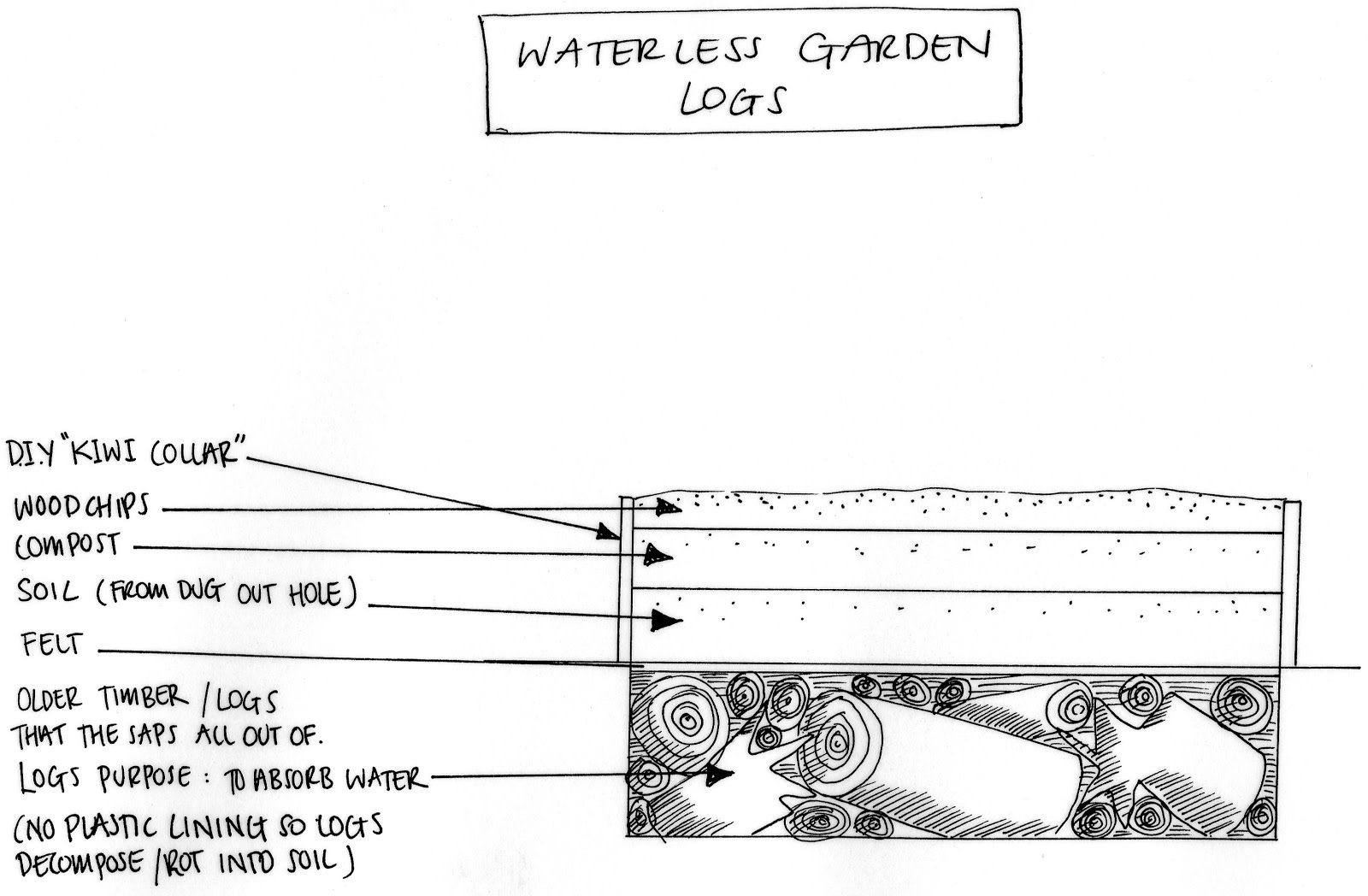
Depending on weather conditions it could be a good idea to actually line this with plastic. I know on the illustration
it says don't need lining but Lincon and Philippa have noticed with the dry weather that it would have been a much
better idea to line it. The 'Kiwi collar' in this image can also be dug into the ground, it does not have or need to be above ground to work. Decisions can be made to suit the design you desire for your project. 
This is an experiment and not sure how it is going. We are going to also try one with small pebbles and woodchip and see what happens. Same concept as above. The layers can be used and modified for your particular project.
An experiment with collecting dew  to water plants. - we suggest plastic lining for both logs and rocks at this time
condensation collecting area in the waterless garden


Once again we suggest to line the dug out area with plastic. (The wood is underground)


'Hotspot' in the waterless garden project
Thank you to AJ and Mary, Philippa and Lincon for some of the photos in this post.
Thank you also to AJ for demonstrating and bringing our awareness to this method of gardening. 

Saturday, January 12, 2013

'Summerfest 2012 Project'

We recently held 'Summerfest', a week long project that included different projects with the intention that those who came could learn techniques based on love that are logical and beautiful* that are applicable to their backyards or acreage. It was a project with lots of different learning experiences so that those who attended and volunteered their time could leave with skills and knowledge on how to do what they learned at home and teach it to others. Below is a summary and thank you to those who volunteered and contributed their time, expertise and energy to these projects.

The week of the ‘Summerfest 2012 Project’ - 28th November to 3rd of December 2012, held at Kyabra Station (Kyabra Learning Centre, Kentucky, NSW), was a great week full of various fun filled activities. 

We began and ended with a focus on large scale soil improvement and water management, demonstrating methods using contours and ponds to redirect and retain water, building living eco systems to provide fertility and regenerate soil, and seeding of grasses and re generation plants to prevent soil erosion. This project took longer than expected with some of the pond walls needing adjustments to hold water properly.

There is still some work to be done in this area to complete the project but a lot of headway was made and we are so grateful for all volunteers time in beginning the project.

the site - Standbye Paddock

Alternate View of Standbye Paddock
Bedrock the beginnings of  erosion at the top of the paddock 

Alternate view of bedrock erosion

Erosion, contours, ponds


Site for contour planting, ponding and living fertility systems:

Contour

Close up of coutour

You can see where the water held and was slowed down
in a shower we had pre-seeding the contour
Harrowing hand planted seeding on the
contours.
Contours at Site (Standbye Paddock):
Digging the Fertility pits
Living Fertility System hole on a contour


The various materials and 'food' for the living fertility systems - use what you
have on hand and have an abundance of. We are wanting to create systems
that are self supporting and that can be done with low cost using what is
available.

Filling up the Fertility pit
Tractor moving 'dead matter' into place

An almost finished Living System - needs some more hay and
matter around the logs so they will break down faster and encourage life
to live there feeling protected and 'safe'.

Fertility pit complete 
Volunteers working at a Living System

Standbye paddock Site showing ponds:

Just dug pond

After a rain. The soil here as you can see in the background is prone to heavy
erosion after rain. The soil is light and fly-away- when exposed.
Working on the bank of one of the ponds. Creating a dam wall to prevent
erosion and cover as much bare soil as possible. (Begin from the bottom up
when creating a dam wall).

 Harrowing the dam wall 

Adding sticks into erosion cracks and at overflow to manage and
slow down water.

Lomandra grasses planted either side of logs - logs
purpose to slow down water flow.

Dam bank complete

Other projects during the week consisted of tending to the swales planted out last year and filling them with gathered matter to transform them into living systems in order to create fertility and improve soil conditions.
Our many thanks to everyone who was on the ‘food’ team for all the living systems spending your days carrying and carting dead wood matter and treading lightly to place it in an already re-generating area. Thank you for your time and care  to disturb as little as possible the new plants and creatures that have been moving in over the last year. Thanks also to our neighbors and Bunnings for supplying much of the ‘dead’matter used to feed the living systems.


'Food' for the Living Systems - Thanks Guys for your help pre - summerfest!

More 'food' for the systems
shredding paper for 'food' for the living systems and
getting the worms going.

shredded cardboard and paper

Other Projects:

Waterless home Gardening project: demonstrating several techniques including fibonacci system to maximize sun and water usage of any area, designing water flow in your garden, techniques to minimize or completely remove the need for watering, mixed planting incorporating natives both flowering and mulching, fruit trees and vegetables. (More detailed information on the Waterless Garden can be found in the blog post titled the same).


Waterless garden before


fibonacci spiral marked out

volunteers creating various systems in the garden

Nature box project: constructing from flat packed pre made kits, painting and positioning boxes for animals and birds according to their particular needs, providing shelter close to food and water. Scouting for suitable locations and some tree climbing to place boxes.


Pre packaged nature boxes, thank you to everyone who made these for us
in Queesland. We are so grateful for all your time and efforts!
Constructed from pre- packaging
eco painting in process

Nature box in place up a tree

‘Reptile Heaven project’: Reptiles are often forgotten or even shunned members of vital ecosystems. This activity focused on providing habitat for reptiles by placing shelter, food and water in close proximity, providing safe transit zones. We utilized above ground living systems to incorporate suitable living shelters and abundant insect life. We also planted various native shrubs, legumes and grasses for protection and mulching. There have already been an increase in numbers of lizards and frogs into the area. 


Reptile Heaven 'before' - looking up the hill

Reptile Heaven 'after' - looking up hill


Reptile Heaven 'after' looking down the hill

Reptile Heaven in progress


Some little frogs who have moved in near by


Worm nursery and breeding centre: Setting up optimal conditions for worm breeding farms and educating about lovingly caring for worms and soil creating creatures.


worms - we love worms!
Worm Breeding Centre under construction -
For more information see blog post on the same
subject.

Worm slurry in the field to add to the living systems to
get the worms started.

We had a marvelous time in the woolshed each evening learning new things in presentations from Jesus and Mary and reflecting on events during the day, as well as much fun dancing, singing and being entertained by wonderful musicians and singers. Our thanks to Jesus and local singer/song writer Fabio Tolli for the evening entertainment. Thank you so much for all the time and gifts to all who planned, prepared and attended these events! We hope you learned heaps and enjoyed it as much as we did!

We want to thank God’s Way of Love Organization (no longer in existence) for all the wonderful contributions they made, Jesus and Mary, the team leaders and supply teams and everyone who participated and volunteered giving their time, resources and efforts to helping us love the land some more. 

We would like to acknowledge the amount of time and effort that went into things such as organizing and pre making animal and bird boxes. We are grateful to everyone who came and made this event such fun and worthwhile this year. We look forward to seeing you again sometime in the near future.

Thanks again 

From the Lytton-Hitchins Family  

For more information or if anything in this takes your interest please feel free to contact us at eloisalh@gmail.com or phone 67787458 or check out www.divinetruth.com for more information on creating loving eco-systems.

* We found out how illogical some of us were or how we sacrificed logic for beauty or beauty for logic rather than having a beautiful balance of both.